
A typical ecology calendar looks like this:
- Day 1: Food chains, webs, and trophic levels
- Day 2: Organism niches and pyramids
- Days 3-4: Carbon and Nitrogen Cycles
- Days 5-6: Symbiosis
- Day 7: Predator-Prey
- Day 8: Ecological Succession
- Day 9: Review
- Day 10: multiple choice assessment
Paradigm shifting this traditional scope and sequence into a problem-based learning unit fosters student problem solving, independence, and engagement and can provide a meaningful learning experience if done correctly. This post provides a roadmap to implementing an effective problem-based ecology project, and a successful project starts with a high functioning group.
Grouping:
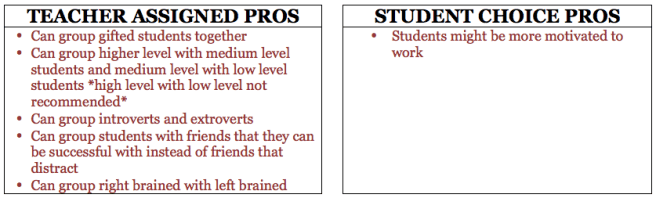
When I was a new teacher I never assigned groups because students practically formed them on their own the minute I said “project”. Over time I learned that being deliberate about creating groups results in higher quality projects and more positive learning experiences. The key to designing successful groups is to be intentional. There is a school of thought that student choice is an integral part of learning, and while I agree that is true in some cases, I strongly believe that the benefits of teacher-assigned groups far outweigh those of student-chosen groups.
Transitioning from “Ecology Unit” into “Ecology Problem”
Day 1: Ecology Introduction and Problem Assignment
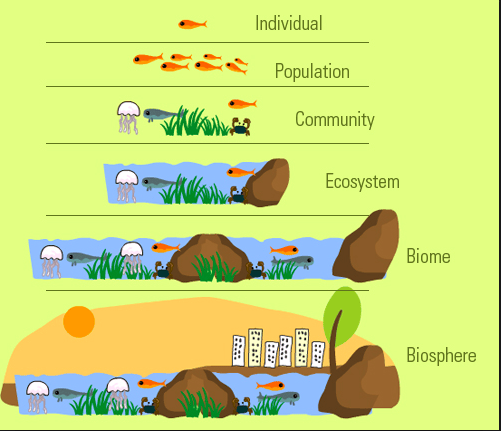
Introduce ecology by discussing the hierarchy of organization as seen in the picture below. Ecosystems include more than just organisms, they also include abiotic factors such as carbon, nitrogen, water, rocks, etc.
After the brief ecological hierarchy introduction, hand out envelopes to each team labeled “NASA: Operation Mars”
The envelopes should contain a piece of paper with the following explanation:
Mission
Your team is working for NASA to develop a plan for creating a city the size of Los Angeles that can sustain life on Mars. NASA has contracted the project out to several ecology firms. They want small firms to generate ideas then collaborate with other elite firms in ongoing summits.
**It is always fun to throw in pop culture, and this trailer can add a little humor before students get started. Use discretion, it has one explicative.**
In the folder they will need the project schedule as shown below. Note that it is ten days long, just as a traditional ecology unit would be. There are research summits incorporated which provide an opportunity for work-checking, feedback, and instruction. These summits are critical for scaffolding and making sure students are solid on the foundation before moving on to harder concepts. I will discuss summit format after describing the project details.
Student Project Schedule (sheet given to students)
Day 1: In order for life to form, abiotic cycles such as the carbon and nitrogen cycle must be established. Make diagrams of each cycle and be able to present ALL important vocabulary involving actions that remove the elements from the atmospheric bank and actions that return elements to the atmospheric bank.
Upon completion, you must discuss primary succession and describe why the abiotic cycles are necessary for it to occur. Describe and discuss pioneer species and give several examples. Describe and discuss the progression of trophic levels and a climax community.
Day 2: Now that a climax community is established, describe every trophic level and organism niches in each level (include 20 organisms, keeping in mind that the goal is an urban ecosystem). Include vocabulary such as decomposer, carnivore, secondary consumer, etc, and be sure to give several examples of each. Each organism should be associated with at least two vocabulary words.
Design and illustrate three food chains with four trophic levels. One food chain must be converted to a pyramid of energy, one food chain must be converted to a pyramid of numbers, and the final food chain must be converted to a pyramid of biomass. Most pyramids will be in the typical triangle shape, although pyramid of numbers and biomass may not be.
Describe why energy pyramids must always be in the typical triangle shape and why numbers and biomass pyramids might look differently. Make sure that one of your pyramids has an atypical shape and explain why it looks differently.
Day 3: Research Summit
Day 4: Food chains are a simplistic view of predator-prey relationships. Food webs are much more complex and show all community predator-prey relationships. Design and illustrate a detailed food web in the ecosystem that has at least 4 producers, 6 primary consumers, 4 omnivores, and 2 tertiary consumers.
Describe and give examples of decomposers, scavengers, and detritivores. Are they shown in food chains and webs? Why or why not?
Describe the 10% rule and the reason for it as well as its significance.
Finally, pick a predator-prey relationship and illustrate a 20 year predator-prey graph. Describe the trends in the graph.
Day 4: Research Summit
Day 5: Food chains and webs show predation, but don’t show the other community interactions including competition and symbiosis (mutualism, parasitism, and commensalism). Describe two examples of each type of interaction in the community that you developed.
Just for fun, here are my favorite mutualism and parasitism clips. Each one has some great higher level questions that can be used in summits.
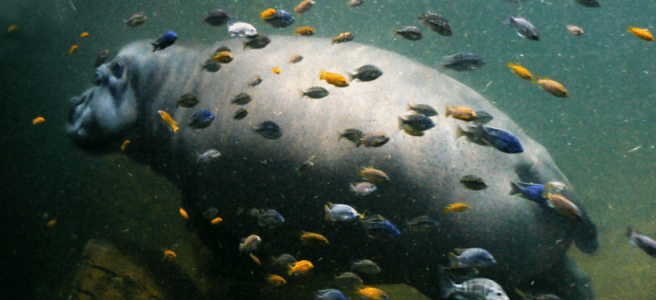
Regarding the mutualism clip – there is also a commensalism relationship shown. What is it? (dung eaters don’t benefit hippo like the fish that clean it do)
Regarding the parasitism clip – how is parasitism similar and different to predation? (both parasites and predators kill, but parasites live on large hosts and feed on it without necessarily killing it)
Day 6: A human brings DDT to the community in order to ensure better crop growth. Discuss DDT – what is it, why is it harmful, and relate it to biomagnification and the term “biodegradable”. Discuss other potential sources of biomagnification.
Discuss what would occur if the whole community was burned in a fire in terms of secondary succession. What could be some other causes for secondary succession?
Day 7: Research Summit
Days 8-10: Final Proposal and Commercial
At this point, students have been exposed to all the targets regarding ecology and have had the opportunity for feedback and discussion. Their job now is two-fold.
- They need to create a comprehensive proposal discussing each task with an array of images. It needs to be typed, bound, and beautiful. The project must be complete at the end of class on day 9 so that on day 10 the teacher can visit with individual groups.
- They need to create a commercial to woo people to populate Mars. Their commercial should highlight their ecosystem and fun things to do and generally convince people to leave Earth. The clip below might be good to show to give them some ideas. An activity like this emphasizes ecology content while building technology skills.
Teacher notes
Problem-based units are different in that they are completely lacking any teacher large group instruction as well as lacking pencil and paper tests. To effectively facilitate such a project, summits are critical for student understanding.
Summits
A summit should almost look like a socratic seminar. It will look similar in that the whole class should be in a circle and it should be question based. Teachers can still be the moderator and “grade” participation by keeping track of student contributions. It will be different in that the teacher will lead the seminar via image analysis as opposed to philosophical questioning. For example, perhaps an aquatic food web will be shown on the overhead. The teacher can ask the large group, “Explain two facts or inferences about this picture”. Students will raise their hands and sequentially discuss the diagrams in detail and bounce questions off of each other. Discussion can go on for 10-15 minutes per diagram, and the teacher should serve as a facilitator (as opposed to a fountain of knowledge) while keeping track of time. The students must educate each other and clarify the project with other “experts” at the summit who are performing the same task. This exercise involves analysis with unfamiliar images of food webs, chains, trophic levels, abiotic cycle images, etc. and will stretch student thinking.
Teacher notes: Grading
For grading, I recommend 2 daily grades and a test grade.
Daily grades:
- Summit Participation (5 or so meaningful contributions per summit for full points)
- On day 10, in teacher individual group visits, ask group members (at random) ten questions regarding their project. For any questions that they cannot explain, deduct ten points.
Test grade:
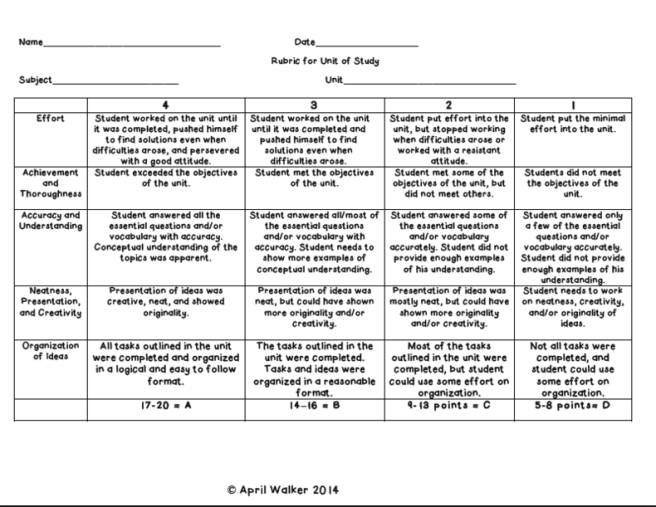
A simple rubric like this will make your life much easier than taking the time to grade every single word and detail. You can develop your own or there are TONS of rubrics and resources on making rubrics on the internet.
Problem-based learning can be incorporated into any unit. As I’ve shared in other posts, I absolutely believe in the lecture/student-note model of learning, but problem-based learning is just as powerful. A classroom that incorporates both is serving our students best by equipping them with a variety of skills.

