
While sometimes I will write about Science, Technology, Engineering, and Math (STEM) education and how to integrate data science into K-12 curricula, today I’ll discuss a research article on a topic I am interested in: marijuana’s effects on Traumatic Brain Injury.
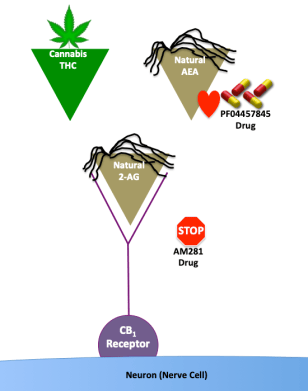
Figure 1. The CB1 receptor. The binding partners 2-AG, AEA, and THC activate the CB1 receptor. The drug PF04457845 delays the degradation of AEA, and thus also activates the receptor. The drug AM281 inhibits the receptor. The molecules with “hair” are natural substances made by the human body. THC, on the other hand, is a molecule made by Cannabis sativa (commonly known as marijuana), an entirely different species.
The article summarized here, Therapeutic Effect of a Novel Fatty Acid Amide Hydrolase Inhibitor PF04457845 in the Repetitive Closed Head Injury Mouse Model, was published in the Journal of Neurotrauma in January of 2019 by primary author Prabhuanand Selvaraj.
Like the Traumatic Brain Injury and CBD paper I discussed a few posts ago (Role of CB2 Receptor in the Recovery of Mice after Traumatic Brain Injury), this paper was also peer-reviewed article by a Ph.D./M.D. committee.
Relevant background on the CB1 receptor:
Figure 1 illustrates how receptors are structures found on the exterior of cells that have binding partners. THC in marijuana binds to the CB1 receptor, causing neurological changes leading to “highs”, relaxation, munchies and other common side effects.
Our bodies make the molecules 2-AG and AEA, also known as endocannabinoids, that bind to and activate the CB1 receptor, as shown in Figure 1. The reason we don’t feel highs from our homemade molecules is because the human body does not waste energy making excesses – they are only made on demand in specific areas. Also, both 2-AG and AEA are degraded really quickly, which is another reason that we don’t feel high from these home grown molecules. The drug PF04457845 used in this study indirectly slows degradation of AEA, and in doing so, increases activation of the CB1 receptor. PF04457845 will be called the “THC Drug” in the remainder of this article. The study uses another drug, AM281, which inhibits the CB1 receptor. For the remainder of this article, AM281 will be called the “THC inhibitor”.
Experimental Design:
For this study, mice were exposed to traumatic brain injury for three consecutive days by anesthetizing them, performing surgery to expose their skulls, then applying impact. Mice that were treated with drugs were given a dose 30 minutes after each impact. Also, they were given a daily dose for five days post-injury. Finally, mouse recovery was measured by three different tests, described below.
Figure 2. Simplified experimental timeline and design (for full schedule, see paper)
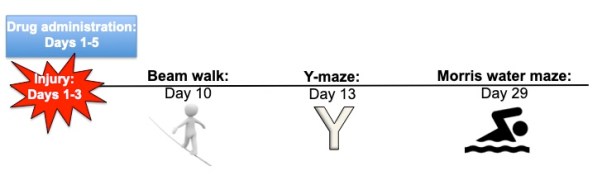
Figure 3. Beam walk test results (for exact data, see paper)
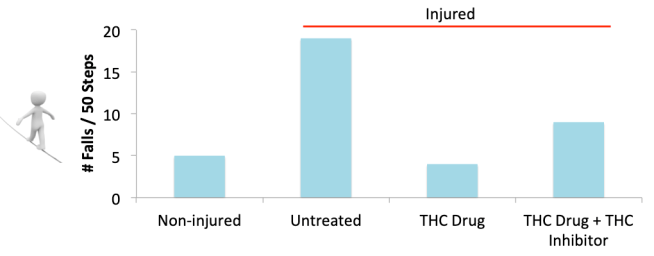
The beam walk was a measure of fine motor movement, and occurred at day 10 of the study. Non-injured mice had occasional missteps, as shown in Figure 3. Alternatively, the injured mice with no treatment had a much higher average, close to 20 missteps per 50 attempted steps. Note that the THC activating drug dramatically reduced the number of missteps, but adding the inhibitor made the drug less effective.
Figure 4. Y-maze test results (for exact data, see paper)
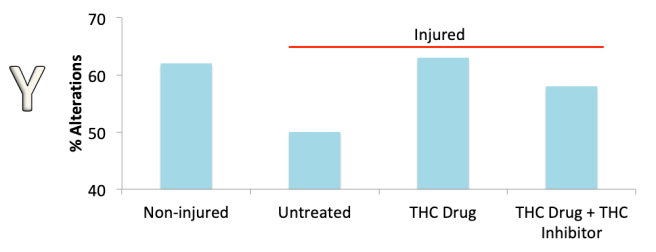 At 13 days after the first injury, mice were placed in a 3-armed maze (Y-maze) and observed for 5 minutes. A visit to one of the arms of the maze was recorded if all four paws were in that arm. An “alteration” occurred when a mouse consecutively entered three different arms. The more alterations, the less a mouse is exploring the same place over and over again. Think of it as a human on a path with a three-pronged fork. If the motivation was to find something interesting in five minutes, most would likely use time efficiently and explore one road fully, then not return to the same road until the other roads had been explored. Mice that return to the same path without exploring the others first “forgot” they had already visited. The lower the alteration percentage means the less efficient their time in the Y-maze. The less-efficient the time in the Y-maze, the poorer their working memory. Note that the non-injured mice and the injured-mice treated with the THC drug had the same exploration efficiency, much higher than untreated injured mice. Adding the THC inhibitor reduced exploration efficiency, suggesting that the CB1 receptor must be important for working memory.
Figure 5. Morris water maze test results (for exact data, see paper)
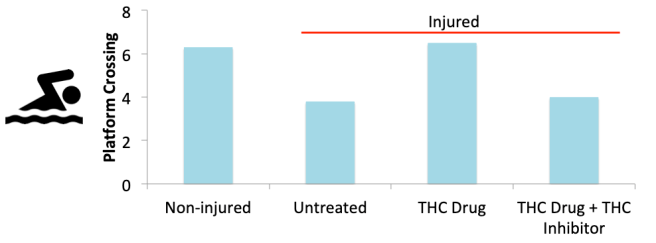
The Morris water maze test was the last test, given at day 29 (over 3 weeks after the drug was administered), and is a measure of spatial learning and memory. The test is performed in a large pool with a hidden platform in it. In this study, mice were trained for several days to learn where the platform was. After training and on test day, the platform was taken away. The mice were then placed in the pool for 60 seconds and their memory was determined by the number of times they crossed where the hidden platform had been.
The more they crossed the platform region, the greater their spatial learning and memory were considered. Very interestingly, the injured mice treated with the THC drug performed just as well as the non-injured mice! Not only that, but the THC inhibitor reduced performance almost to that of the injured but untreated mice, suggesting that the activation of the CB1 receptor is important for memory.
There are many more details and tests discussed in the manuscript that are beyond the scope of this article. I encourage you to read it if you have interest.

