
My first few years of teaching I approached evolution with trepidation. As a teacher in a public school in Texas, I walked on eggshells. After a few years of presenting the curriculum, I became more and more comfortable with it and eventually shouted from the rooftops how interesting it was. It is the most unifying theme of biological sciences, and it is an undeniable force that explains nearly every observation.
In my opinion, taxonomy, or the grouping of organisms, is the critical predecessor to evolution and should be discussed immediately before. At my school, we started with the kingdoms, focusing on their differences in a broad, memorization type of approach followed by specific identification and details. The emphasis on identification was with unicellular organisms via microscope work, as plant and animal diversity and details were subjects that would be investigated in much more depth later in the year. There are tons of lab opportunities with these single-celled organisms by the way. Cocci, bacilli, and spirilli bacteria are easy to identify, and calculating their size involves math and logic. Gram-negative vs gram-positive staining and antibiotic effectiveness is another interesting topic that can be incorporated, as is bacterial presence in food like yogurt (see interesting Yogurt Lab). Protists are a teachers dream because animal-like, plant-like, and fungus-like can all be easily obtained through vendors or pond water, and students can research, identify, analyze, present their favorite protist, and/or personify it with a mock Facebook page Mock Facebook Student Templates. There are so many lab and enrichment opportunities with taxonomy, and if you go into the phylum level and investigation/dissection labs, there are even more.
However you want to approach taxonomy, it makes an easy segue to bridge taxonomy to evolution via the discussion of phylogeny, cladograms, and common ancestry between kingdoms. Darwin himself utilized this famous cladogram pictured below as an image to explain the diversity of species and the relationships between them.
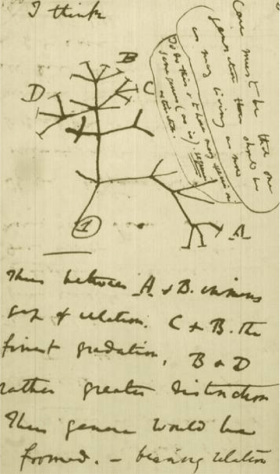
Introducing the “tree of life” above as Darwin called it, then translating it to a cladogram and simplifying it to only show kingdoms, I start evolution with a flat-out statement that, “Evolution IS NOT synonymous with humans come from monkeys”. I explain monkeys are a totally different branch of descent and that in studying evolution, we are simply examining that our ancestors were different species that are now extinct. Students have surely heard of Lucy, and if not, here is a quick youtube to stimulate some discussion: “Lucy” our ancestor, and an even better article found here. Lucy was not a monkey, yet she was not a human. She was somewhere on the road to Homo sapiens, the species we are today. She and her people had children and the children of their children of their children (and so on, for 3.2 million years) branched into different species over time as environments changed. Eventually, we emerged.
To illustrate such a point, a famous Darwinian example is the finches observed on the Galapagos islands. On his naturalist voyage, he noted on these islands, that are peppered in the Pacific Ocean, the birds on different islands had many common characteristics but also many differences. They were not of the same species because they could not reproduce, yet their similarities strongly suggested a relationship. He used this observation to explain the notion that the common ancestor (bird on the mainland) offsprings offsprings offsprings (and so on, through however many generations) that traveled to other islands changed in subtle ways that were magnified over time, eventually creating another branch in the tree of life.
A simple interactive explanation can be found here: Galapagos Bird Explanation. A classroom activity that I have found to be fun and get the point across can be found here: Battle of the Beaks. To make the activity a higher level one, as well as a digital one, students could be asked questions on Google Forms like this one Google Form Example and incorporate another example for extension Peppered moth extension
After establishing the concept of common ancestry and that we did NOT come from monkeys (we are different branches of evolutionary tree) and showing this Beatles analogy that beautifully shows speciation in a clever way…
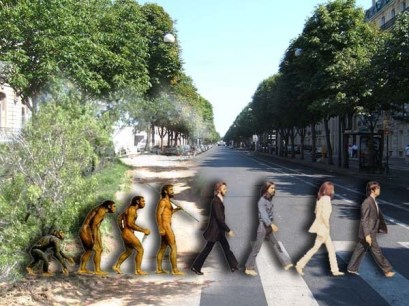
…I then profess my love for Charles Darwin, I called him my boyfriend before I got married.
Charles Darwin is my hero. His conclusions on heredity without doing experiments like Mendel or without knowing about hereditable factors (not discovered until Griffith with his famous transformation experiment in the early 1900s) were genius considering they were only based on observation.
I went to a conference in Houston once and attended a talk from a man who was as passionate about evolution as I have become – in fact, he might be the reason I pretty much attribute every biological concept to evolution in some way.
The first thing he did was give a brief biography on Darwin that made me fall in love with the man. Darwin LOVED science, even though he was slow in grade school, and was pushed into med school by his father simply because he didn’t really have a professional direction. He hated it and was the kind to faint at the sight of blood. After dropping out, he joined the clergy and became a naturalist (one who studies nature). He was asked to travel on the voyage on the ship the HMS Beagle and roam around the world to observe and report on biological attributes of different places, and he was delighted until he stepped on board and became seasick.
One of his destinations was the Galapagos Islands, where not only did he observe birds and their likenesses, but he also observed other life forms, including turtles.
Here, the man went on a tangent that I will never forget for the rest of my life, so I will incorporate it, just because it is interesting if nothing else. He talked about the turtle shown below, Lonesome George (rest in peace), the last of his species that could have been as old as 150 years. This talk was prior to 2012 (the year of George’s unfortunate death), and the presenter revealed that scientists had been trying for years to get Lonesome George to mate to continue his line, but George simply could not in captivity, despite them going to extreme measures. I cannot imagine what that entails beyond dim lighting and Barry White.
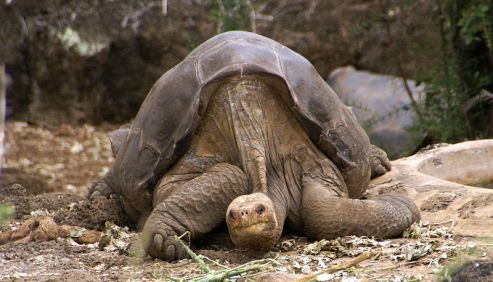
After his brief fun fact about my favorite turtle, he then described Darwin’s personal life. Post-traveling, Darwin went back to London and married his cousin Emma. In deciding on whether or not to marry her, ever the scientist, he wrote a list of pros and cons of the institution of marriage to confirm moving forward:
Pros: children, companionship thats better than from a dog
Cons: loss of bro-time, probably will get fat
Evidently, the pros out-weighed the cons, and he married her and they had a wonderful life together. She loved him deeply (way better than a dog). He was ill much of the time with an undiagnosed disease, and Emma cared for her sickly husband unwaveringly. She would read to him every night and play the piano for him (she was trained by Chopin). They played backgammon every day and went on walks. Unlike most men of his peerage, he didn’t rely on a governess to occupy his children’s time but instead gave them his attention. He had ten children, and two died as infants while one died at ten, breaking his heart.
He never lost his love for science. Every day, sometimes more than once, he would go on a walk on a gravel path near his home. Depending on the complexity of the problem, he would stack stones prior to walking. He had a walking stick and knew he had a tendency to get lost in his thoughts, so each circle or lap, he would knock a rock down until he had none left, thus ending his musings and sending him back to his family.
I could go on and on about evolution, but instead of continuing, I am going to break up this post and discuss on Friday the evidences for evolution and some ideas for activities. Stay tuned…
If you have time for utter-silliness…My students for my birthday one year due to my constant mention of Darwin made me a youtube e-card featuring him: The Birthday with Darwin -scroll to the end after the random gingerbread appearance for the Darwinian debut. PS. The randomness of this video not only makes me smile because it was so kind of them, but also it reflects their savviness with computers and solidifies my commitment to incorporating technology, it is their language.

