
To begin part 2 of my post on evolution, I encourage you to skip to minutes 49-56 of this mock movie clip. To get the most out of this post, view the clip before proceeding.
I first saw the video at a conference in Houston, and it explains so well that natural selection is a theory, just as cell theory (all living things are made of cells) and atomic theory (all matter is made of atoms) are. Cells and atoms are taught in schools with no controversy, and because evolution is the best explanation for biodiversity with volumes of supporting evidence, it should be as well.
The video highlights the most significant evidence there is, biochemical analysis. It illustrates the chromosomal similarities between humans and primates, and shows evidence of a genetic difference (fact), provides a logical and probable explanation behind it (theory) by examining DNA sequence and chromosome structure (fact). Further biochemical analysis zooms into chromosomes to analyze DNA sequences, revealing a significant homology, or similarity across species, in the proteins that each gene codes for. For example, cytochrome c protein, important in metabolism (in the electron transport chain in the mitochondria), has 104 amino acids. See the following amino acid sequence differences in the image below.
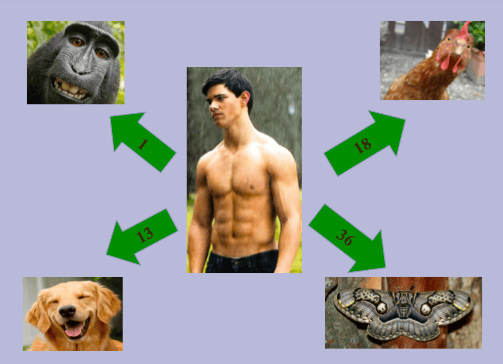
The fact that out of 100 building blocks for protein (think of a paper with 100 words), that only one “word” between the two species is different strongly suggests a common ancestor. If two students handed in a 100 word essay and there was only one word different, no doubt about it, they would have consequences for cheating. It is too coincidental for so much homology to exist without some sort of commonality. Biochemistry is the strongest evidence for evolution there is, and I imagine that fact, along with morphological analysis, is one of the reasons scientists realized that whales are more closely related to humans than sharks.
Speaking of whales, fish, and humans, before DNA sequencing and visualization, there was plenty of support for Darwin’s theory based simply on observation. A very compelling evidence for natural selection are structures that are considered “vestigial”, or useless remains of something that was once important. For example, whales have pelvises, but they are tiny and non-functional (suggesting their ancestors walked on land). There is a species of fish that lives in caves that are blind, yet they have a collapsed eyeball covered by a thin layer of skin. Obviously, they don’t use the eye, but the fact that it is there means they have the DNA for it, which suggests that they inherited that DNA from an ancestor who used eyes. Humans have a number of vestigial structures including a tailbone and the appendix.
Homologous structures, alternatively, have similar structures but different functions. For example, consider the human arm, cat leg, whale fin, and bat wing. The mammalian structures serve very different functions, but if analyzed, have similar bone structure, location, and joints, suggesting common ancestry.
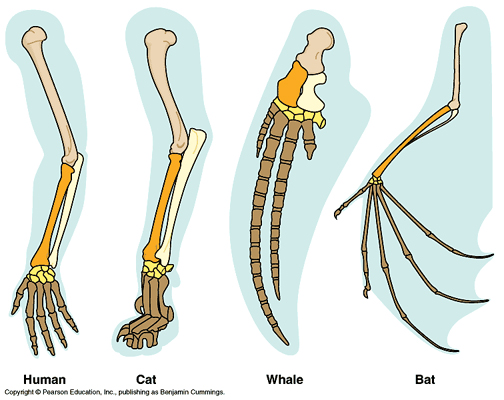
Note this is a Pearson/Prentice Hall Education image.
One of my favorite reinforcers to do in class is for students to do a t-chart on a large piece of butcher paper. On the left they list as many vestigial structure examples that they can (without using their phone), and on the right, they list as many homologous structures that they can (sans phone). I give them 5-10 minutes, depending on their engagement level, then we stop and have a contest to see who generated the most. I start with homologous structures. Each group presents one while explaining their reasoning, then we go around until all have been presented.
The reason for presentation is two-fold: #1. It is different, they get the chance to lead a large-group discussion, which is valuable. #2. I am the judge. If they say a bogus homology, I will “object” and then the class will have a large group discussion to see whether it should be valid or not. It is amazing what they come up with. My favorite discussion was on the pair baleen and teeth. That was one I objected to, just to stop and initiate further processing, and we had a very interesting discussion where they investigated using phones. Then, we concluded as a large-group that they are, indeed, homologous. To conclude the lesson, the winning group usually gets a high five or something, the uniting of homologous structures in the classroom.
Other evidences include biogeography, fossil evidence, embryological developmental similarities, as well as observable events like the finches or the peppered moths I discussed in the last post (here is a great activity on pocket mice from HHMI that includes worksheets, teacher guides, and videos, which is another great observable event).
After discussing the evidence for evolution, the best part of the unit is discussing the mechanism for it – natural selection. Natural selection is synonymous with “survival of the fittest” and is impossible without genetic variety causing some organisms of the same species to be “stronger” than others. A discussion of how “stronger” is referring to the presence of adaptations, rather than muscles, can be emphasized by imagery using this video.
Two of my favorite clips from this video are Bird Dance and Ant vs Fungus. Chimpanzee Behavior is also interesting, but a little gross (after years of teaching experience, the “shockers” keep engagement levels high and initiate high-level discussion, so I show them in class).
In this video, there are so many different adaptations that students discover. On the bird dance alone they discuss physical ones like feathers and behavioral ones like dances and female choosiness. Post-video, I have them discuss their favorites, then each group presents an adaptation observed, initiating a large group discussion. These kinds of activities (group analyzing and presenting) can reinforce concepts much better than simple lecture because it makes students process on their own and bridges curriculum to the real world. *PS. Ant vs Fungus is the favorite of all students, and it is mine too. It is amazing, breathtaking music, shocking, and definitely worth a look*
A funny video that discusses mating adaptations is here. It is a little bit eyebrow raising, but I am telling you, the advantage of this is if you are short on time and can’t show a long movie like Planet Earth, this can serve as a great transition by getting their attention and initiating discussion. Or it could be a great warm-up.
On Tuesday I will discuss a very relevant and evolution-related concept, antibiotic resistance, and will bridge to a new topic – bacteria.

