
Peer-reviewed articles are considered the gold standard in the scientific community, as anyone can publish anything on the internet; thus I will only discuss data from articles that are reviewed by Ph.D./M.D. committees prior to publication.
Here, I discuss a paper published in February of 2019: Role of CB2 Receptor in the Recovery of Mice after Traumatic Brain Injury. It was published in the Journal of Neurotrauma by primary author Lital Magid. I’ve simplified her figures and won’t discuss much of the molecular biology findings in the paper, so I encourage you to visit her article for more details.
Crucial background:
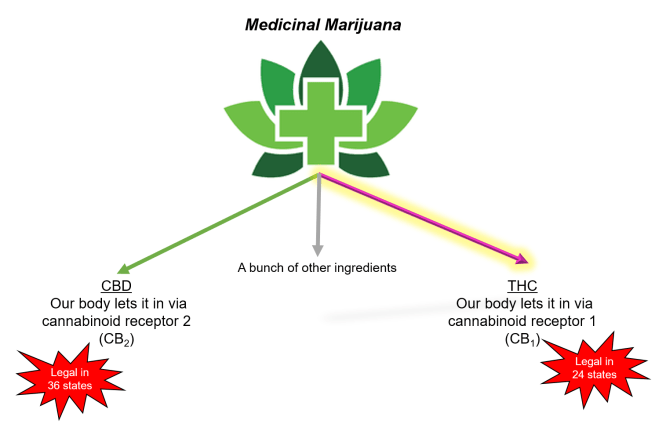
- There are two receptors that let marijuana into the cells of our body.
- CBD, the ingredient used in CBD oil, enters via the second receptor.
- THC, the controversial ingredient responsible for “highs”, enters via the first receptor.
- The study involved two molecules that affect the CBD receptor CB2: HU-910 and its sister drug HU-914, both of which have anti-inflammatory properties.
Experimental Design:
Warning to rodent lovers: you might hate the design of this study, but please keep reading to see the impressive evidence collected. To test the effects of CB2 activators on Traumatic Brain Injury in mice and rats, the lab first performed surgery on the rodents to expose their skull (while anesthetized of course), and used a weight to apply trauma. In the experiments I discuss here, rodents were only given one dose of the CBD activator HU-914 one hour after surgery, then they were monitored for as long as 5 weeks post-injury. To measure physiological effects, the rodents were then observed and given scores on various behavioral and motor tasks. MRIs were also performed.
Results:
Figure 1 shows that HU-914 had a significant effect (significance is indicated by the stars – the more stars, the more significant) on neurological functioning of injured rats at every time point. In other words, HU-914 treated rats (blue squares) improved in the performance of neurological tasks much more than non-treated (red circles). Notice the yellow triangles, which indicate the changes in neurologic function of rats given both the drug and a CBD receptor inhibitor. The down arrows indicate that from 2 days to 14 days, the inhibitor decreased the beneficial effects of the drug significantly.
Figure 1. CB2 Activator Improves Neurological Function in Rats.
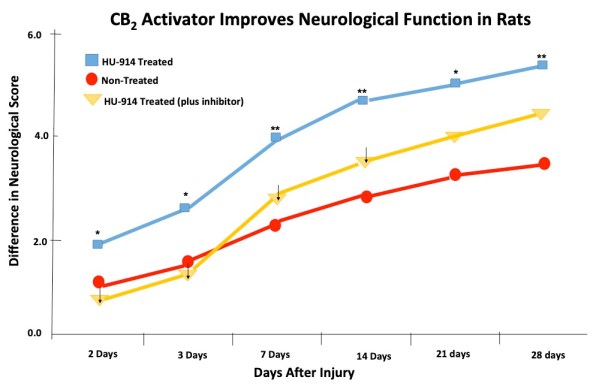
Figure 2 shows results from knock-out mice (mice that completely lacked the CBD receptor). Again, the blue square treated mice performed better than the red circle non-treated. However, note the purple diamonds, which shows that the drug did not work at all in the mice without the receptor.
These functional studies are in two different animals with two different validation strategies (inhibiting the receptor and completely removing it). Both methods show that the CBD receptor activator helps the animals improve cognitive functioning after brain injury.
Figure 2. CB2 Activator Improves Neurological Function in Mice.
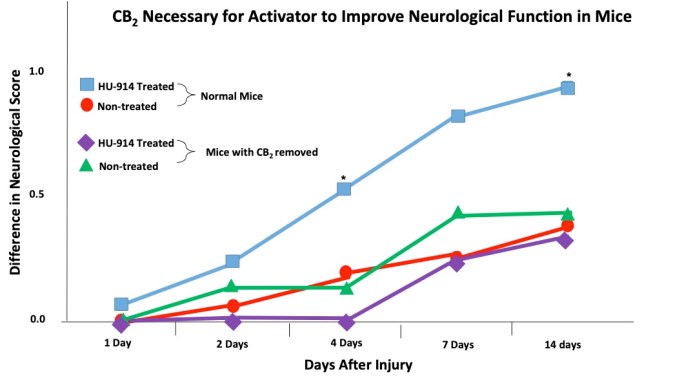
Figure 3. CB2 Activator Increases the Brain’s Physical Recovery after Trauma.
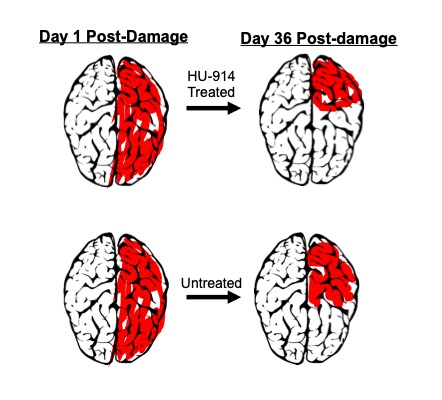
In addition to functional changes, the study also showed that there were physical protective effects from treatment with CBD receptor activators. They saw that the HU-914 treated mice had about a 76% recovery after about 5 weeks, whereas the untreated mice had about a 65% recovery, as illustrated in the simplified cartoon shown in Figure 3.
What about traumatic brain injury and the THC receptor?
It is fairly irrefutable that activating the CB2 receptor both physically and functionally helps with traumatic brain injury recovery. In the next article, I will discuss if the controversial THC receptor has the same effect.
Until next time,
Kelly Daescu

