
As my blog’s intended audience is biology educators, as always, I will pepper my discussion with resources I have used in the classroom that have facilitated student understanding and success. This post will focus on the most prevalent prokaryotes, the kingdom Bacteria. It will discuss how antibiotic resistance is an example of natural selection, thus providing a perfect bridge between microevolution and macroevolution (see my previous evolution posts) to bacterial structure and function. This lab, in my experience, clearly conceptualizes how bacterial diversity can lead to natural selection of superbugs like MRSA. An extension article involving MRSA found here was published in the prestigious journal Nature and is a fantastic higher level analysis that could supplement a lesson on antibiotic resistance. Finally, my post will touch on the ambiguity of bacterial roles in ecosystems, as they can be friends or foes, depending on the strain.
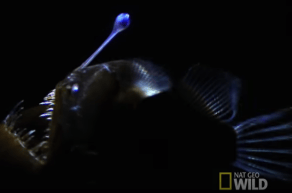
Bacteria have a nefarious reputation, yet they perform essential ecological functions; the photosynthetic variety provide life-sustaining oxygen, and the decomposers prevent ubiquitous piles of dead organisms rotting in the street. On a more interpersonal level, the flora/fauna-fest that resides in our intestines help us with digestion, and many other organisms benefit from bacteria as well, such as the angler fish shown in the video here. The clip tells the story of two interesting co-dependent relationships. One involves a beautiful bioluminescent bacteria that provides light in the deep ocean so its host can find prey. The other co-dependent relationship, which has nothing to do with bacteria, is just a bonus. I dare you to watch and witness one of the strangest romances I have ever seen as well as mother nature’s twisted side.
There is also a dark side to bacteria, as we all have experienced. A relative lightweight is the bacteria that feeds on debris in our mouth. Brief note – regarding the human mouth, what a dichotomy! We have sensitive taste buds where we can worship vices like Godiva cheesecake, yet we also have this gaping hole in our face that invites bacteria as wells as viruses, ill-intentioned protists, and worms into our bodies with open arms. I suppose the size and complexity of the human body requires an enormous amount of energy to maintain, so it is an unavoidable reality that we need a mechanical powerhouse with teeth, jaws, and muscles, but it is a shame we have this unfortunate vulnerability as well. Plaque is an unavoidable enemy we encounter daily, and if we are lucky that is the only bacteria we meet, because the heavy-weights like tuberculosis and syphillis can be deadly. Even the notorious throat-infecting strep that once hid undetected in my son by displaying symptoms of stomach cramps instead of a sore throat could have been deadly if left untreated. Pathogenic bacteria are cunning tricksters and shameless opportunists.
Thankfully, we have a tool to outwit these parasites. In this case, the pen is indeed mightier than the germ because 24 hours a day, ERs are open and any doctor can easily write a prescription for an antibiotic. The accidental discovery of Penicillin in the late 1800s began an era of antibiotics, and now there are over 100 that are specifically utilized to treat different offenders. Before treatment, however, doctors must first identify the pathogen by determining if it is “Gram negative” or “Gram positive” (see shutterstock image below).
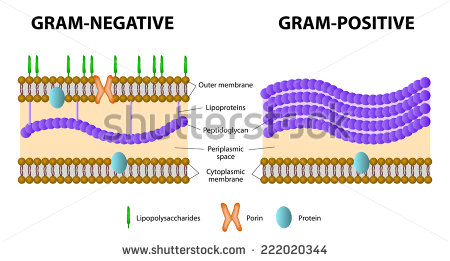
Notice that the glaring difference between the two is in their cell wall. Gram-negative bacteria have a thin layer of a complicated carbohydrate called peptidoglycan sandwiched between two membranes, while Gram-positive have many layers of peptidoglycan on the exterior. Gram staining is an identification technique that takes advantage of the differential absorbance of a bio-stain due to exterior structure (see image). Gram-negative bacteria have an outer membrane which can make them more resistant to some antibiotics. Also, many antibiotics inhibit peptidoglycan cross linking and are more effective on gram-positive strains. Due to the variety in bacteria and specific mechanisms of antibiotics, doctors first must investigate the perpetrator so they can treat accordingly.
Despite the advancements in healthcare and increases in life expectancy since antibiotic use became routine, our arsenal of treatment is in danger due to the growing problem of antibiotic resistance. Some aggressive bacteria are immune to even the most powerful antibiotics. Think about this: if a single bacterium has a mutation allowing it to evade antibiotic attacks and can reproduce every 20 minutes, it would create 32,768 identical clones in just 5 hours. If we do not have effective tools to treat a mutated strain that has become deadly, the consequences would be catastrophic. Experience has taught doctors to prescribe antibiotics for a course of several days. The first few days eliminate the majority of the infection; however, there are still some lingering bugs, and these are the ones that possibly have an advantage through a favorable mutation. Continuing antibiotics is critical to make sure that even the scrappers, the fighters who simply do not want to go down, are eradicated, because if those fighters were allowed to grow free reign, it would be much harder to destroy them should they proliferate again because they have already become resistant (not necessary completely, it takes more than one mutation to reach that level of immunity, which is again why antibiotic treatments should be taken until completion).
The public is not educated enough of the possible consequence of not following the prescribed regimen which can allow a resistant strain to establish residence and easily spread to humans that are in close proximity. This and the inappropriate treatment of viral infections with antibiotics can lead to widespread resistance. Far more antibiotic use than even in the medical field is in animal and plant production. The non-discriminate use of antibiotics in our ecosystems in order to maximize profit is a massive contributor to the problem of antibiotic resistance.
The video below is FABULOUS at discussing and illustrating bacteria and the issue of antibiotic resistance.

There is one more important point I want to make before signing off, and that is regarding bacterial reproduction, also known as binary fission. It is hard for me to predict what pre-knowledge students have when they walk into the classroom, but I am pretty sure they know that humans reproduce sexually. I am also confident that they know that plants reproduce sexually via “birds and bees” that transfer pollen (sperm) from one flower to another. I have always wanted to show this clip from my favorite childhood movie to introduce plant sexuality, but I never have just because the content gets overly obvious. A couple of paragraphs down I include an appropriate sexual innuendo that I do discuss, but only for this reason: biology has been compared to a foreign language due to the intense amount of vocabulary that it involves. Vocabulary retention is a huge obstacle because if students don’t remember the words, no way can they achieve understanding and mastery. Humor and mnemonics help.
Students already know sexual reproduction and what that entails, so silly movie clips are unnecessary; however, they may not know that bacteria reproduce asexually, which begs the questions of how do they get the genetic changes that make them resistant to drugs, and how do completely different bacteria with different sequences of DNA obtain the exact same mutation to become resistant to the exact same antibiotic?
The simple answer to bacterial genetic change is that they acquire mutation due to mismatches in DNA replication, and in environmental stress they even have the ability to increase rate of mutation. This does not explain how resistance passes between species.
“Horizontal gene transfer” is a more complicated mechanism where bacteria obtain exogenous foreign DNA and incorporate it into their genome. There are four types of horizontal gene transfer in bacteria, and the image below beautifully contrasts three of the four mechanisms (the image comes from a useful resource found here).
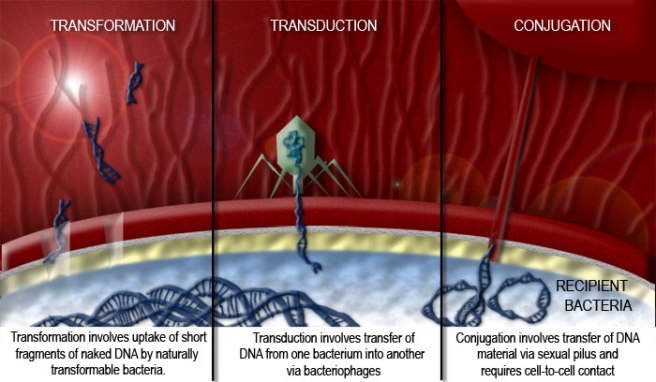
*The scary looking bacteriophage is simply a virus that only infects bacteria*
Note that conjugation is about as close as you get to bacteria sex , as it involves the direct transfer of bacterial DNA from one to another through an extension called a sex pilus. This sexual innuendo I do not pass up simply because it enhances content retention. I familiarly dub “conjugation” as a “conjugal visit” and flat out point out the obvious analogy between the pilus and the penis. I mean come on, they start with the same letter, have the same number of letters, and kind of sound like each other.
A final method of genetic change in bacteria that can occur both internally and via horizontal gene transfer is through transposable elements. These “jumping genes” switch their location in the bacterial genome through “cut and paste” mechanisms. Specific DNA sequences act as tags for cutting, and enzymes including transposase switches the DNA around.
Interestingly, horizontal gene transfer can occur between species in completely different kingdoms, and the next post will focus on the eukaryotic genome (that of Animals, Plants, Fungi, and Protists) starting with their versions of transposable elements.

