When people think of diabetes many of them associate it with obesity, which is actually correlated with only type 2 diabetes. This post will focus specifically on type 1 diabetes, which is an endocrine system problem. The endocrine system, as any biology teacher knows, involves delivery of hormones. I never know when high school students walk into my classroom if they know anything about hormones other than that testosterone and estrogen makes them have massive make-out sessions in the hallways and elsewhere. I don’t know if they know about growth hormone’s affect on development, adrenaline’s fight or flight effect, or the importance of insulin.
They do come with a preliminary knowledge of the digestive system, as shown in the video here.

As shown so graphically, the mouth and stomach mechanically and chemically digest food. Enzymes in our saliva start the breakdown (delighting our tastebuds) and the enzymes in the stomach, not the acid, is what actually further digests food. The acid simply allows the enzymes to shape correctly, otherwise mis-folding occurs, rendering the protein useless. The stomach acid is also for defense purposes, as it is inhospitable to other living organisms and can destroy microbes that we unknowingly ingest.
What I don’t think students have considered is that the journey continues. The video does a fabulous job of showing the post-stomach digestion as well as the villi, the hair like projections that significantly increase the surface area of the small intestine. Their job is like that of a towel, to increase efficiency of soaking up material (the fluffier the towel, the more effective). The soaked in sugar is then transferred into the circulatory system and delivered to every single cell in our body, which is critical because our cells cannot function without food. The pancreas, a low profile organ, plays a vital role in what comes next.
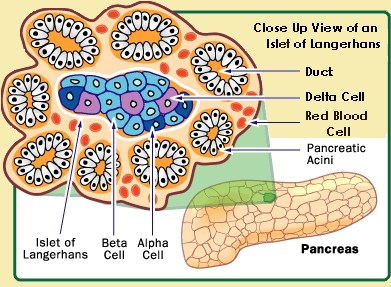
website source
Most of the pancreas functions as an exocrine gland, meaning its secretions don’t circulate with blood like hormones. Its function is to deliver digestive enzymes directly into the small intestine. The rest of the pancreas, the endocrine portion, consists of the isles of Langerhans, literally little islands scattered throughout the pancreas. These islets contain beta cells that secrete insulin and alpha cells that secrete glucagon. These hormones have opposite functions and both are critical for blood sugar regulation.
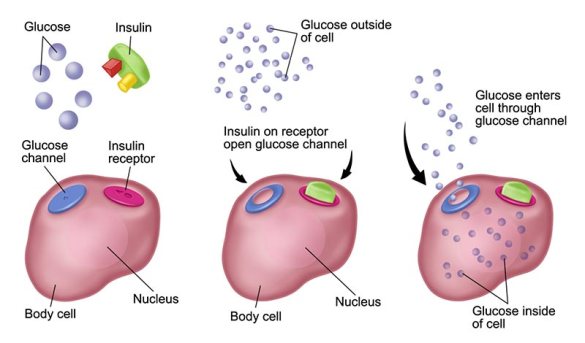
The glucose sucked in the blood by the small intestine is far too big to diffuse across a cell membrane. It needs a channel protein to pass, and the insulin secreted by beta cells in the pancreas acts like a key that allows that gate to open and let glucose in. See here for an article that describes this action in detail. The picture below gives a great visual.
So, if cells need food and insulin opens the gate for food to enter, why are these gates regulated? Why do they ever close? They close because if glucose isn’t in the blood, it can’t feed brain cells, and if brain cells lack food, they stop working. If there is not enough glucose in the blood to be delivered to the neurons in the brain, hypoglycemia results and the consequences are disastrous. If low blood sugar does not get treated, it will result in death. I had a student a few years ago whose sister died in her sleep from hypoglycemia, and it broke my heart. If you click on this link,#singfornicole, read her story, and then press the play button, you will understand.
Here is a very simple movie that I used to show to my 9th graders because it has such great visuals at the cellular level. It is low level and simplistic but can be a fabulous intro and provide an engaging opportunity for extension. If they watch this video, then design a paper or project on how it could have been made higher-level, it would be an excellent analysis and synthesis level activity that reinforces the content.
Occasionally, people without diabetes can feel hypoglycemic and a little dizzy. Most likely what is happening is that the balancing hormone glucagon is delayed for some reason. Glucagon is actually present and functions correctly in diabetics, although it cannot be effective with sustained hypoglycemia.
Glucagon’s role in blood sugar management is to stimulate the liver to secrete glycogen, an animal starch (complex carbohydrate) that has long chains with branches of glucose. It is like an emergency sugar reserve. If the liver dumping glycogen into the bloodstream is ineffective and blood sugar continues to plummet, seizures can occur, a last attempt by the body to release sugar via muscle contractions (muscles are high energy using cells and have sugar reserves as well). I knew a man who had diabetic seizures occasionally, and after every one, he would have these things I called “eye spots”, little red dots surrounding his eyes. I never knew why, but later I looked it up and as it turns out, it is actually petechia, a condition arising from severe physical trauma.
Here is a website that features this image and offers a fabulous overview on how insulin and glucagon normally coordinate.
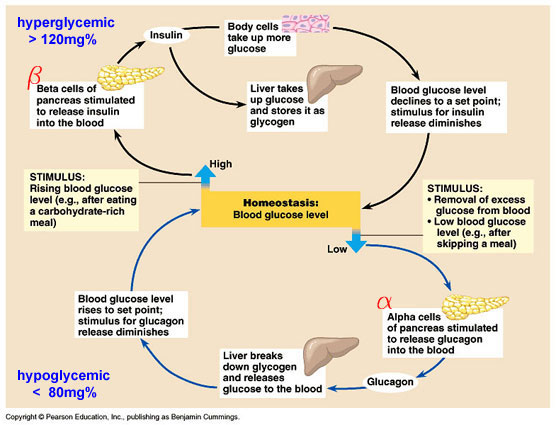
Diabetics not only have to worry about hypoglycemia, but if they fail to take enough insulin and hypergylcemia results, consequences can be just as deadly. Severe hyperglycemia will result in coma and eventually death because the starving cells have no access to energy and stop metabolizing.
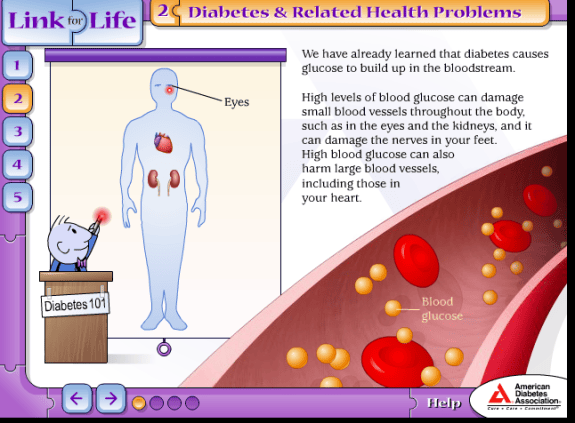
With diabetes, it is possible to live with bouts of hyperglycemia that are treated before becoming life-threatening, but after years of sustained high blood sugar, even if it is on and off, it can be detrimental. You might have heard that diabetes is associated with foot amputations, which is true for a variety of reasons. First, with a lack of insulin cells are starved, and they have no access to fuel. Also, high blood sugar is thick and over time will harden and constrict small blood vessels (capillaries) resulting in poor circulation. Starved neurons result in nerve damage and decreased sensation. People with desensitized feet can injure them and not know which can cause infection and deformities. Diabetes is also associated with blindness because perpetual high blood sugar can similarly constrict the capillaries of the eye, depriving it of critical materials.
I honestly don’t know how this disease can even exist. Pre-pharmaceutical industry, there was no insulin for treatment. How could our ancestors have survived this disease long enough to pass the gene onto children? I know it is a delayed onset and can arise in childhood, but how many 10 year olds are having babies? It is not just genetic though, it has been proven that that there is an environmental component as well. There is a book that suggests maybe diabetes could provide a selective advantage in certain environmental conditions. If that is true, then the gene could have arisen in a specific population, then spread as humans became more mobile. Chapter 2 of a book called Survival of the Sickest by Dr. Sharon Moalem offers a compelling argument that diabetes has a selective advantage in colder climates. Her hypothesis is supported by its overrepresentation in cold regions (Finland, Sweden, and Norway) and the existence of a wood frog that utilizes high blood sugar like antifreeze to prevent from hypothermia. She discusses the wood frog, Rana sylvatica, that externally freezes solid in cold weather after drastically elevating its blood sugar to maintain cellular osmolarity, then comes back to life when it defrosts. I am not kidding. Check out this video.
However diabetes entered our gene pool, it is a tragic disease. Great news is that with treatment, it can be managed.
1922 was when insulin was first used on a patient. The discovery resulted in a Nobel Prize shortly after (see article). Now, there are insulin pumps, which mimic pancreas activity by delivering low, basal, rates of insulin with the ability to administer high doses with meals. Insulin shot therapy is an alternative treatment, and there is long acting insulin designed to provide that basal, low dosage, then rapid acting insulin administered with meals. Shots are less predictable than insulin pumps making it slightly more difficult to maintain stability, but they are less expensive, making them an attractive choice for therapy. Additionally, there is the ability to monitor blood sugar levels with finger pricks that release a drop of blood and are analyzed by a small machine. There are also constant glucose monitoring systems that can be worn and synced to smart devices to deliver alarms, but they are expensive.
There are also more advanced therapies that are in the process of being developed. Islet transplants are an experimental procedure, and here is a scholarly explanation, but as a scientist, I see two fundamental problems with it. First, diabetes is an autoimmune disease, it is when the body destroys its own beta cells. If there is something about the cells that the immune system recognizes, which is a real possibility, it seems likely that the body would destroy the transplanted cells. Also, any organ donation means the recipient has to take immunosupressants for life so that their immune system does not destroy the foreign cells. Is it worth taking immunosupressants and facing vulnerability to other illnesses when diabetes can be managed with a pump?
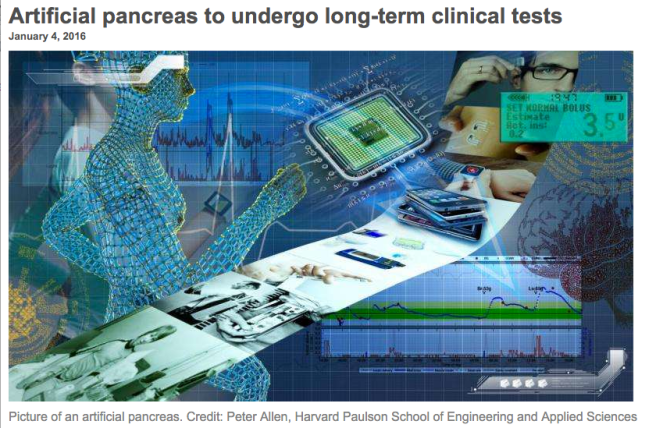
There are also hopes of developing an artificial pancreas, which seems impossible to me, but 20 years from now it might very well the preferred treatment, if people can afford it.